
Diploma in Professional Accounting
Diploma for Financial Advisers
Registered HMRC Tax Agent
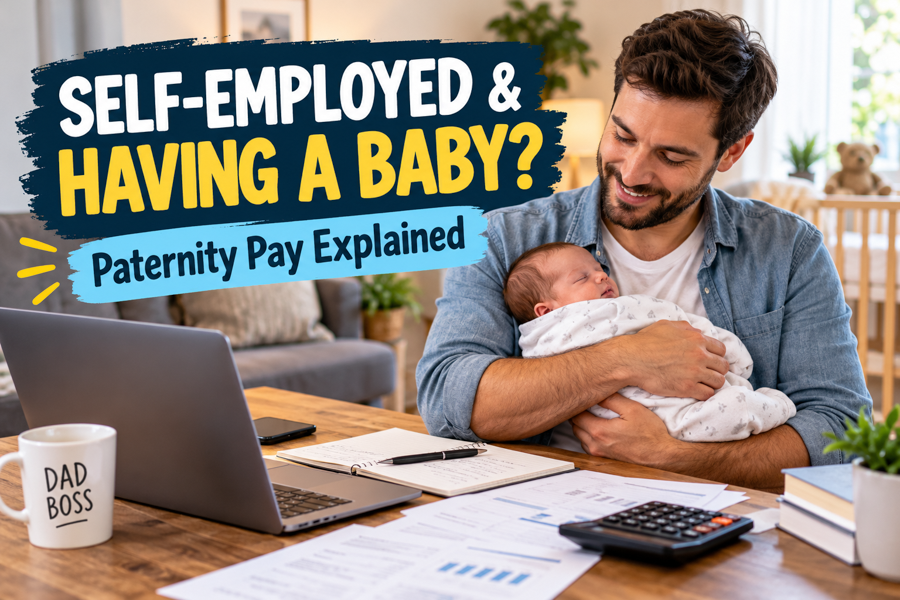
Becoming a parent is an exciting time, but if you work for yourself, you might be worried about losing income when your baby arrives. Unlike employees, self-employed people do not usually receive paid time off from an employer, so planning ahead is particularly important.
Understanding paternity leave self employed UK rules can help you decide how much time to take off, how to manage your business and whether you can claim any financial support. If your partner is self-employed and expecting a baby, it is also worth understanding the maternity benefits available to her.
The good news is that there are ways to prepare financially, and self-employed mothers may qualify for Maternity Allowance even if they do not qualify for Statutory Maternity Pay.
This guide explains the rules in straightforward English, including what happens if you are a sole trader, run a limited company or have a partner who is self-employed.
Table of Contents
- Paternity leave self employed UK: What are your rights?
- Maternity pay for self employed UK: What financial support is available?
- Can a self-employed father claim paternity pay?
- How much Maternity Allowance can a self-employed mother receive?
- How does being a sole trader or limited company director affect your entitlement?
- How can self-employed parents prepare financially for a new baby?
- How do you apply for maternity benefits in the UK?
Paternity leave self employed UK: What are your rights?
If you are self-employed in the UK and your partner is having a baby, you can take time away from your business to support your family. However, you do not normally qualify for Statutory Paternity Leave or Statutory Paternity Pay solely through self-employment.
The reason is straightforward: statutory paternity leave is an employment right, while statutory paternity pay is normally paid through an employer to an eligible employee or worker.
If you operate as a sole trader, you are generally responsible for deciding when you work and when you take time off. You can arrange to stop accepting jobs, reduce your working hours or temporarily close your business, but you will need to consider how this affects your income.
For example, imagine that you are a self-employed electrician who normally earns £3,000 a month before tax and business expenses. Your partner is due to have a baby in December, and you want to take two weeks off to help at home.
You can arrange those two weeks away from work, but you would not automatically receive two weeks of statutory paternity pay from the government. Unless you have another source of income or qualify for a separate benefit, you will need to cover your household expenses from your savings or other available income.
What if you are employed as well as self-employed?
The situation may be different if you have a job alongside your business.
For example, you might work three days a week for an employer and run a gardening business on the remaining days. Your employment may give you access to statutory paternity leave and pay if you meet the relevant eligibility conditions.
Having a separate self-employed business does not automatically prevent you from qualifying through your employment.
However, you should check your employment status and the rules that apply to your particular circumstances. Simply receiving payments from a company does not necessarily mean that you are an employee.
The official GOV.UK guidance on paternity pay and leave eligibility explains the conditions you must meet.
Can self-employed fathers take shared parental leave?
Shared Parental Leave and Shared Parental Pay have their own eligibility requirements.
If you are genuinely self-employed and do not have qualifying employment, you cannot normally claim these employment-based entitlements simply because your partner qualifies for maternity benefits.
If you have a separate job, however, you may qualify through that employment, depending on the circumstances and the applicable rules.
It is worth checking before your baby arrives rather than assuming that your partner’s entitlement automatically gives you the same rights.
Maternity pay for self employed UK: What financial support is available?
If you are self-employed and pregnant, you may be entitled to Maternity Allowance, a government payment designed to support eligible people who take time away from work because they are having a baby.
Maternity Allowance is particularly important for self-employed mothers because they do not normally qualify for Statutory Maternity Pay through self-employment alone.
Statutory Maternity Pay is generally paid by an employer to eligible employees. Maternity Allowance, on the other hand, can be available to self-employed people who meet the relevant conditions.
According to GOV.UK’s Maternity Allowance guidance, eligible claimants can receive the payment for up to 39 weeks.
Who can claim Maternity Allowance?
You may qualify if you have been registered as self-employed for at least 26 weeks during the 66 weeks before your baby’s expected due date.
You will also need to meet the applicable contribution requirements to determine how much you receive.
You may still qualify if you have recently stopped working, so it is worth checking your circumstances even if you are no longer actively trading.
The rules also cover certain people who work unpaid in their spouse’s or civil partner’s business. In qualifying circumstances, they may receive Maternity Allowance for up to 14 weeks.
How much is Maternity Allowance in 2026/27?
For the 2026/27 tax year, the maximum standard weekly rate for an eligible self-employed claimant is £194.32 a week.
Depending on your circumstances and National Insurance contribution record, you could receive between £27 and £194.32 a week for up to 39 weeks.
The maximum possible payment over 39 weeks is £7,578.48, assuming you qualify for the full weekly amount throughout the entire period.
Here is a simple illustration:
| Weekly payment | Payment over 39 weeks |
|---|---|
| £27 | £1,053 |
| £100 | £3,900 |
| £150 | £5,850 |
| £194.32 | £7,578.48 |
These figures are illustrations of the total payments at each weekly rate, not predictions of what an individual will receive.
Your actual entitlement depends on the rules and your National Insurance contribution record.
Do you need to pay National Insurance to qualify?
Your National Insurance record can make a significant difference to the amount you receive.
To qualify for the maximum amount available under the self-employed rules, you generally need to have been registered with HMRC for at least 26 weeks during the 66 weeks before your baby is due and to have paid Class 2 National Insurance contributions for at least 13 weeks in that period.
If you have paid fewer than 13 weeks of contributions, your allowance may be lower.
GOV.UK explains that you may be able to make additional contributions after applying to increase your entitlement. HMRC will tell you what additional contributions are needed.
This is why it is sensible to check your National Insurance record early rather than waiting until your maternity leave is about to begin.
Can a self-employed father claim paternity pay?
In most cases, a father who is exclusively self-employed cannot claim Statutory Paternity Pay simply because his partner has given birth.
There is no general government paternity payment specifically for all self-employed fathers.
However, your circumstances may be different if you have employment alongside your business or qualify for other financial support.
For example, if you work for an employer and also operate a small online shop, you may be able to claim statutory paternity pay through your employment if you meet the eligibility requirements.
For 2026/27, the standard weekly rate of Statutory Paternity Pay is £194.32 or 90% of your average weekly earnings, whichever is lower.
Eligibility normally includes having been continuously employed by the same employer for at least 26 weeks up to the relevant qualifying week, earning an average of at least £129 a week and remaining employed up to the date of the birth. You must also give the required notice.
Since 6 April 2026, eligible employees have been entitled to paternity leave from their first day of employment, although the separate qualifying conditions for statutory paternity pay still apply.
You can check the current requirements on the official GOV.UK paternity pay and leave page.
What if you cannot afford to take time off?
If your income depends on the number of jobs you complete, taking time off can be difficult.
There are several practical steps you can consider:
- Build up savings before your partner’s due date.
- Complete important jobs in advance where possible.
- Arrange temporary cover with another self-employed person.
- Discuss deadlines with regular customers.
- Consider taking a shorter break followed by reduced working hours.
- Check whether your household qualifies for other government benefits.
For example, a self-employed plumber might arrange for another qualified plumber to handle emergency calls while taking a week off after the birth.
This approach will not work for every business, but planning ahead can reduce the pressure to return to work immediately.
How much Maternity Allowance can a self-employed mother receive?
The amount depends mainly on your National Insurance contributions and whether you meet the eligibility requirements.
For the 2026/27 tax year, a self-employed mother who qualifies for the maximum amount can receive £194.32 a week for up to 39 weeks.
Someone with a lower qualifying contribution record may receive less.
The following example shows why checking your entitlement matters.
Imagine that you are a freelance graphic designer and your baby is due in March 2027. You have been registered as self-employed for more than a year, but you have not paid enough qualifying Class 2 National Insurance contributions to receive the maximum allowance.
You should still check whether you qualify for Maternity Allowance and whether making additional contributions could increase the amount payable.
Do not assume that you receive nothing simply because you have not paid the full number of contributions needed for the maximum rate.
When can you apply?
You can apply for Maternity Allowance once you have been pregnant for 26 weeks.
Payments can start from a date between the 11th week before your baby is due and the day after the birth.
You do not have to wait until the baby arrives before making your claim.
It is sensible to apply as early as you can within the permitted period, particularly if you need to plan your household budget.
Can you receive Maternity Allowance if you are still working?
Being self-employed does not automatically mean that you must close your business to apply for Maternity Allowance.
However, the payment is intended to support eligible people around childbirth, and the circumstances of your claim matter.
You should check the current rules and make sure the information you provide to the Department for Work and Pensions is accurate.
Also remember that Maternity Allowance can affect other benefits. For example, it is taken into account when calculating Universal Credit, so your overall household income may not increase by the full amount of the allowance.
For more information, read the official GOV.UK guidance on Maternity Allowance payments.
How does being a sole trader or limited company director affect your entitlement?
Your business structure can affect how you arrange time off and what benefits may be available.
If you are a sole trader
As a sole trader, you and your business are not legally separate. You generally decide how much work to undertake and when to take time off.
You do not receive a salary from your business in the same way an employee receives wages. Instead, your taxable business profit is generally calculated from your business income less allowable expenses.
If you take two weeks away from your business, you may earn less during that period, particularly if you charge customers for your time.
You should therefore consider your household expenses, business commitments and any regular payments that will continue while you are away.
If you need help understanding how your business income is taxed, our guide to how self-employed people pay tax in the UK explains the basics.
If you operate through a limited company
The position can be more complicated if you are a director of a limited company.
A company director may also be an employee of their own company, depending on the circumstances. Having a director’s title or receiving dividends does not automatically establish eligibility for statutory employment benefits.
If you receive a salary through PAYE and have an employment relationship with your company, you should check your employment status and the relevant eligibility rules.
Do not assume that paying yourself a salary automatically means that you qualify for Statutory Paternity Pay. The detailed conditions still need to be satisfied.
You should also distinguish between money belonging to your company and money available to you personally.
For example, if your company has £15,000 in its business bank account, that does not necessarily mean you can withdraw the entire amount to cover household expenses. The company must meet its own liabilities, and payments to you must be made through an appropriate method.
Planning ahead is particularly important if your business relies on your personal work to generate revenue.
Can you employ someone to cover your work?
You may be able to arrange temporary cover while you take time off.
For example, a self-employed builder might subcontract suitable work to another contractor, while a consultant could arrange for a trusted colleague to handle urgent client requests.
If you run a limited company, you might ask an employee to take on additional responsibilities temporarily.
However, you should consider the cost of the cover, any contractual obligations and whether the arrangement is appropriate for your industry.
The aim is to protect your business relationships without putting unnecessary pressure on your family during the first few weeks after the birth.
How can self-employed parents prepare financially for a new baby?
Financial planning is particularly important when your income depends on the work you complete.
Unlike an employee who qualifies for statutory maternity or paternity benefits, a self-employed parent may have to rely more heavily on savings, business arrangements and any benefits available to them.
A useful starting point is to estimate how much money your household will need each month while one parent takes time away from work.
Include essential costs such as:
- Mortgage or rent payments.
- Council Tax and household bills.
- Food and transport.
- Existing loan and credit repayments.
- Business insurance and other essential business expenses.
- Baby equipment and other new family costs.
Next, estimate how much income you expect to receive during that period.
For example, if your normal household contribution is £2,000 a month and you expect to have £800 a month available from other income, you will need to cover the £1,200 monthly shortfall.
If you expect to take two months away from work, you would need approximately £2,400 to cover that shortfall, before allowing for unexpected expenses.
This is a simplified example, but it illustrates why calculating the likely shortfall before the birth can be useful.
Should you consider income protection insurance?
Some self-employed people have income protection insurance, which can replace part of their earnings if they cannot work because of a qualifying illness or injury.
However, ordinary income protection policies should not be assumed to cover maternity leave, paternity leave or a voluntary break from work.
Check the wording of your policy carefully, including exclusions, waiting periods and the circumstances in which payments are made.
If you are considering a policy, ask the insurer directly whether it provides any relevant cover for pregnancy-related circumstances.
You can also read our guide to income protection insurance and tax deductibility for the self-employed.
The tax treatment of insurance premiums depends on the type of policy and the circumstances, so do not assume that every premium is an allowable business expense.
Do not forget your tax payments
Taking time off may reduce your business profits, but you should not automatically assume that your tax payments will fall immediately.
If you complete a Self Assessment tax return, your payments on account may be based on your previous tax liability. You may be able to apply to reduce them if you reasonably expect your tax bill to be lower, but you should make sure your estimate is realistic.
Reducing payments too far could leave you with an unexpected balance and interest to pay later.
You should also keep enough money available for business expenses and tax liabilities that remain payable while you are away.
How do you apply for maternity benefits in the UK?
If you are self-employed and expecting a baby, the main step is to check your eligibility for Maternity Allowance.
The application process involves providing information about your circumstances and supplying the supporting documents requested.
You can use the official Maternity Allowance application guidance on GOV.UK to find out how to apply.
Step 1: Check your eligibility
Review the qualifying work period, your self-employment registration and your National Insurance contribution record.
If you have recently started trading, your entitlement may depend on how long you have been registered and how many qualifying contributions you have made.
Step 2: Gather your documents
You may need evidence of your expected due date and information about your employment or self-employment.
Check the current application instructions carefully so that you provide the correct documents.
Step 3: Submit your application
Follow the GOV.UK instructions and submit your claim within the permitted period.
If you are unsure whether you qualify, do not automatically rule yourself out. Check the official eligibility guidance or contact the relevant government service for clarification.
Step 4: Check your other benefits
Maternity Allowance can affect other benefits, including Universal Credit.
If your household receives means-tested support, consider how the new payment may change the amount you receive overall.
You should also review your budget to account for any reduction in earnings while you take time away from your business.
Conclusion: Plan ahead for paternity leave and maternity pay
Understanding paternity leave self employed UK rules can help you make informed decisions before your baby arrives.
If you are a self-employed father, you can arrange time away from your business, but you will not normally qualify for Statutory Paternity Pay through self-employment alone. If you also have qualifying employment, you may have additional rights.
For self-employed mothers, Maternity Allowance can provide valuable financial support for up to 39 weeks. The amount you receive depends on your eligibility and National Insurance contribution record.
The most important steps are to check your entitlement early, calculate how much money your household will need and make arrangements to keep your business running where possible.
If you run a small business and need help understanding your tax position, bookkeeping or Self Assessment obligations before taking time off, Better Account can help you keep your finances organised, so you can focus on preparing for your growing family.
—- Bookkeeping & Accounts
Finished reading?
Get tax advice from a professional accountant.
Book a free 15-minute chat and I’ll explain what you need to do, answer your questions, and let you know how I can help.
No commitment · Free 15-min call