
Diploma in Professional Accounting
Diploma for Financial Advisers
Registered HMRC Tax Agent
If you are self-employed in the UK, creating invoices is something you will probably need to do regularly, whether you provide professional services, work as a contractor, carry out building work, sell products, or run a small business from home. An invoice is simply a document that tells your customer what you have provided, how much they need to pay and where they should send the money, but it is also an important part of your business records because it helps you keep track of your income and provides evidence of the money your business has earned.
Many people who become self-employed for the first time are unsure about what an invoice should look like, whether there is a specific HMRC invoice template they have to use, what information they need to put on it, and how long they need to keep their invoices. The good news is that there is no complicated official invoice form that every sole trader has to use. You can create your own invoice using Word, Excel, accounting software or an online invoice template, provided that it contains the information required for your circumstances.
How to create an invoice as a sole trader in the UK?
Creating an invoice as a sole trader is relatively simple. You can create one yourself using a document or spreadsheet, or you can use accounting software that automatically produces invoices for you.
Your invoice should clearly show who is providing the goods or services, who the customer is, what work was carried out or what was supplied, the amount being charged and when payment is due.
A simple invoice normally starts with your business name or your own name, followed by your contact details. You should then give the invoice a unique invoice number and the date on which the invoice was issued.
Underneath this, include your customer’s name and, where appropriate, their business name and address. You should then provide a clear description of the goods or services you supplied.
For example, if you are a self-employed electrician, you might describe the work as “Electrical installation work carried out at 25 High Street” rather than simply writing “Electrical work”. The more clearly the invoice describes what you have charged for, the easier it will be for both you and your customer to understand the transaction later.
You should then show the price, any VAT if you are VAT registered, the total amount due and your payment terms.
If you are new to self-employment, it is also worth making sure that your business records are organised from the beginning. If you have not yet registered as a sole trader, you can read our guide to registering for Self Assessment as a sole trader before you start trading.
What to include on invoice?
A self-employed invoice should contain enough information for your customer to understand exactly what they are being charged for and enough information for you to identify the transaction when you prepare your accounts or Self Assessment tax return.
A typical invoice should include:
- Your name or business name
- Your business address or contact address
- Your email address or telephone number
- The customer’s name and address
- A unique invoice number
- The invoice date
- The date the goods or services were supplied, if different from the invoice date
- A description of the goods or services
- The quantity or number of hours, where relevant
- The price for each item or service
- Any discount provided
- VAT, if you are VAT registered
- The total amount payable
- Your payment terms
- Your bank details or other payment instructions
You do not necessarily need to include every possible piece of information on every invoice, but your invoice should be clear and complete enough that there is no confusion about what the customer is paying for.
Do I need an invoice number?
Yes, it is strongly recommended that you give every invoice a unique invoice number.
There is no need to make invoice numbers complicated. You could simply start with INV-001, followed by INV-002, INV-003 and so on.
Alternatively, you could use a system such as 2026-001, 2026-002 and 2026-003, which makes it easier to identify invoices by year.
The important thing is that your numbering system is consistent and allows you to identify individual invoices. Avoid giving two different invoices the same number because this can make your accounting records unnecessarily confusing.
If you cancel an invoice or issue a credit note, keep a record of what happened rather than simply deleting the original invoice from your records.
Do I have to put my name and address on an invoice?
If you are trading as a sole trader, you should make it clear who is responsible for the business.
If you trade under your own name, you can simply use your personal name on the invoice. If you use a trading name, you can show the trading name as well, but you should still make it clear who the legal business owner is.
For example, an invoice could show:
Better Building Services
John Smith
10 Example Street
Cambridge
CB1 1AA
This makes it clear that Better Building Services is the trading name and John Smith is the individual operating the business.
Your customer also needs enough information to identify who they are paying, so their name and address or business details should normally be included.
Do I need to put VAT on my invoice?
This depends on whether you are VAT registered.
If you are not VAT registered, you should not charge VAT to your customers or show an amount described as VAT on your invoice.
If you are VAT registered, your invoices will need to contain the appropriate VAT information, including your VAT registration number and the VAT charged.
This distinction is important because being self-employed does not automatically mean that you are VAT registered. VAT registration is a separate matter and depends on your circumstances and taxable turnover.
If you are unsure whether VAT should appear on your invoices, it is worth checking your VAT position before sending invoices to customers.
What payment details should I put on my invoice?
Your invoice should make it easy for the customer to pay you.
For a bank transfer, you can normally include:
Account name: John Smith
Sort code: 12-34-56
Account number: 12345678
Payment reference: INV-001
You should also state when payment is expected.
For example, you might write:
Payment due within 14 days of the invoice date.
Alternatively, you might require payment immediately, within 7 days or within 30 days, depending on the agreement you have with your customer.
It is a good idea to agree your payment terms with customers before you start the work, particularly if the job is large or involves significant costs.
Can I use a self employed invoice template?
Yes. There is no requirement for a sole trader to create invoices using a particular HMRC template.
You can create your own self-employed invoice template in Microsoft Word or Excel, use accounting software, or use another suitable invoicing system.
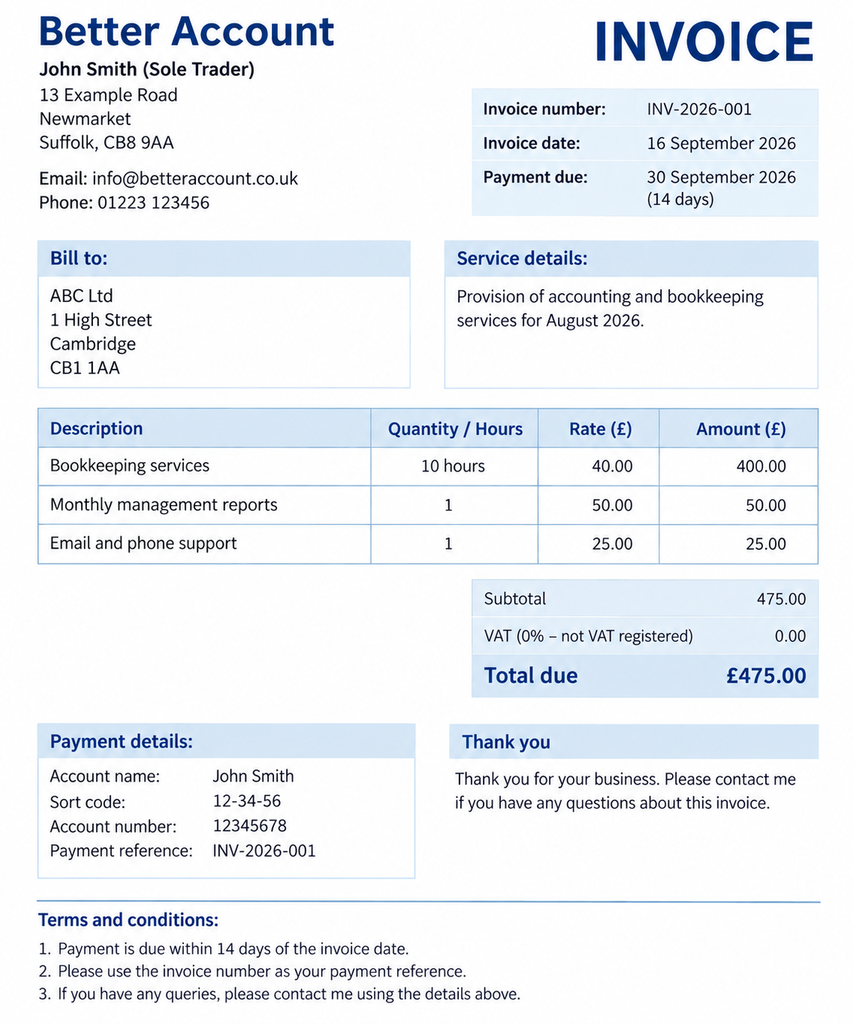
A basic template could contain the following structure:
INVOICE
Your business name
Your name
Your address
Email / telephone
Invoice number: INV-001
Invoice date: 16 September 2026
Payment due: 30 September 2026
Bill to:
Customer name
Customer address
Description:
Website design – 10 hours @ £40 per hour
Subtotal: £400.00
VAT: £0.00
Total due: £400.00
Payment details:
Account name
Sort code
Account number
You can then save this document as your standard invoice template and change the customer, invoice number, dates and amounts each time you issue an invoice.
Do I need to keep copies of invoices I send?
Yes. You should keep records of invoices that you issue, as well as records of the money you actually receive.
Your invoice records help you establish how much income your business has generated and allow you to check whether customers have paid you.
You should not simply create an invoice, receive the money and then delete the invoice.
Instead, keep a copy of the invoice together with the relevant payment record and any other documents that help explain the transaction.
Keeping everything organised throughout the year makes completing your accounts and tax return much easier.
If you complete your own tax return, our guide explains how to do a Self Assessment tax return yourself and what you need to consider before submitting it to HMRC.
How long do self-employed people need to keep invoices?
You should keep your business records for the period required by HMRC.
For Self Assessment, HMRC generally requires records to be kept for at least 5 years after the 31 January submission deadline for the relevant tax year.
For example, records relating to a tax return for the tax year ending 5 April 2026 would normally need to be kept until at least 31 January 2032, although there can be circumstances where records need to be kept for longer.
It is therefore sensible to keep invoices, receipts, bank records and other business documents in an organised system rather than deleting them once a customer has paid.
Should I keep invoices digitally or on paper?
You can keep your records digitally, and for many small businesses this is much easier than keeping boxes of paper invoices.
You could save invoices as PDF files in folders organised by year, customer or invoice number. Alternatively, accounting software can store invoices and link them to payments received.
Whatever system you use, make sure you can find the records when you need them.
A simple folder structure might look like this:
Business Records
→ 2026/27
→ Sales Invoices
→ Paid Invoices
→ Unpaid Invoices
The exact system is up to you, but consistency is more important than having a complicated system.
What happens if a customer does not pay my invoice?
An unpaid invoice is still part of your business records, so you should not simply remove it because the customer has not paid.
You should keep a record of the invoice and the steps you have taken to recover the money.
Depending on your accounting method and the circumstances, the tax treatment of unpaid invoices can become more complicated, particularly where you later decide that a debt is genuinely bad or unlikely to be recovered.
For larger amounts, it may be sensible to get professional advice rather than simply writing the invoice off.
Can I invoice a customer before I finish the work?
Yes, depending on the agreement with your customer.
Some businesses request a deposit before starting work, while others invoice when the work is completed. You might also agree staged payments for a large project.
For example, a contractor might request 30% before starting work, 40% when a particular stage is completed and the remaining 30% when the project is finished.
The important thing is to make the payment arrangement clear to your customer and ensure your invoices accurately describe what the payment relates to.
If you receive money before completing the work, make sure your accounting records correctly reflect the transaction.
Do invoices matter for my Self Assessment tax return?
Yes. Your invoices are an important part of the records you can use to establish your business income.
When you complete your Self Assessment tax return, you need to report your business income and allowable expenses accurately. Your invoices can help you establish what you have earned during the tax year and provide a useful audit trail if HMRC ever asks questions about your figures.
However, your invoices should not be the only records you keep. Your bank statements, receipts, expense records and other relevant documents should also be retained.
The easiest approach is usually to keep your business records up to date throughout the year rather than trying to reconstruct everything shortly before the tax return deadline.
—- Bookkeeping & Accounts
Finished reading?
Get tax advice from a professional accountant.
Book a free 15-minute chat and I’ll explain what you need to do, answer your questions, and let you know how I can help.
No commitment · Free 15-min call